Ask how much an electric car costs to run and you'll hear confident numbers, but most of them rest on assumptions that may not match your situation: a particular electricity price, a particular car, a particular amount of driving. The honest answer is that it depends, and the good news is you can work it out for yourself quite easily. This guide shows how, using your own electricity bill, your driving, and official figures from the Green Vehicle Guide.
Home < public
Charging cost
Generally, per Green Vehicle Guide
Medium
BEV maintenance rating
energy.gov.au (petrol: high)
kWh × rate
Charging cost formula
Plus losses
The cost categories to compare
To compare an EV with a petrol, diesel or hybrid car fairly, look at the total cost of owning it over the years you expect to keep it:
- purchase price, less any discounts or concessions, plus on-road costs;
- energy: electricity for an EV, fuel for a petrol or diesel car, both for a plug-in hybrid;
- servicing and repairs;
- tyres;
- insurance;
- registration and any road user charges;
- finance costs, if you borrow;
- resale value at the end.
Energy costs and servicing are where EVs usually differ most. Purchase price is often higher; the Green Vehicle Guide notes EVs generally cost more to buy than petrol or diesel vehicles, though it expects prices to become more competitive as more models become available.
Working out your charging cost
The arithmetic is straightforward:
Cost per charge = energy added (kWh) × your electricity rate ($ per kWh), plus charging losses.
Some energy is lost as heat when charging, so the energy drawn from the wall is a bit more than the energy that ends up in the battery. Our charge time estimator assumes about 10% losses as a rough allowance.
To get a cost per kilometre:
- Find the car's energy consumption, in kWh per 100 km or Wh/km. The Green Vehicle Guide lists it for each EV.
- Find your electricity rate on your bill or plan. If you're on a time-of-use plan, note the off-peak rate and when it applies.
- Multiply consumption by rate, and add your loss margin.
For example, if a car uses X kWh per 100 km and your rate is Y cents per kWh, 100 km costs roughly X × Y cents, plus losses. Using your own numbers matters because electricity prices vary widely between plans, networks and times of day.
The Green Vehicle Guide's home charging calculator can also estimate charging time and cost for a chosen vehicle.
Where you charge makes a big difference
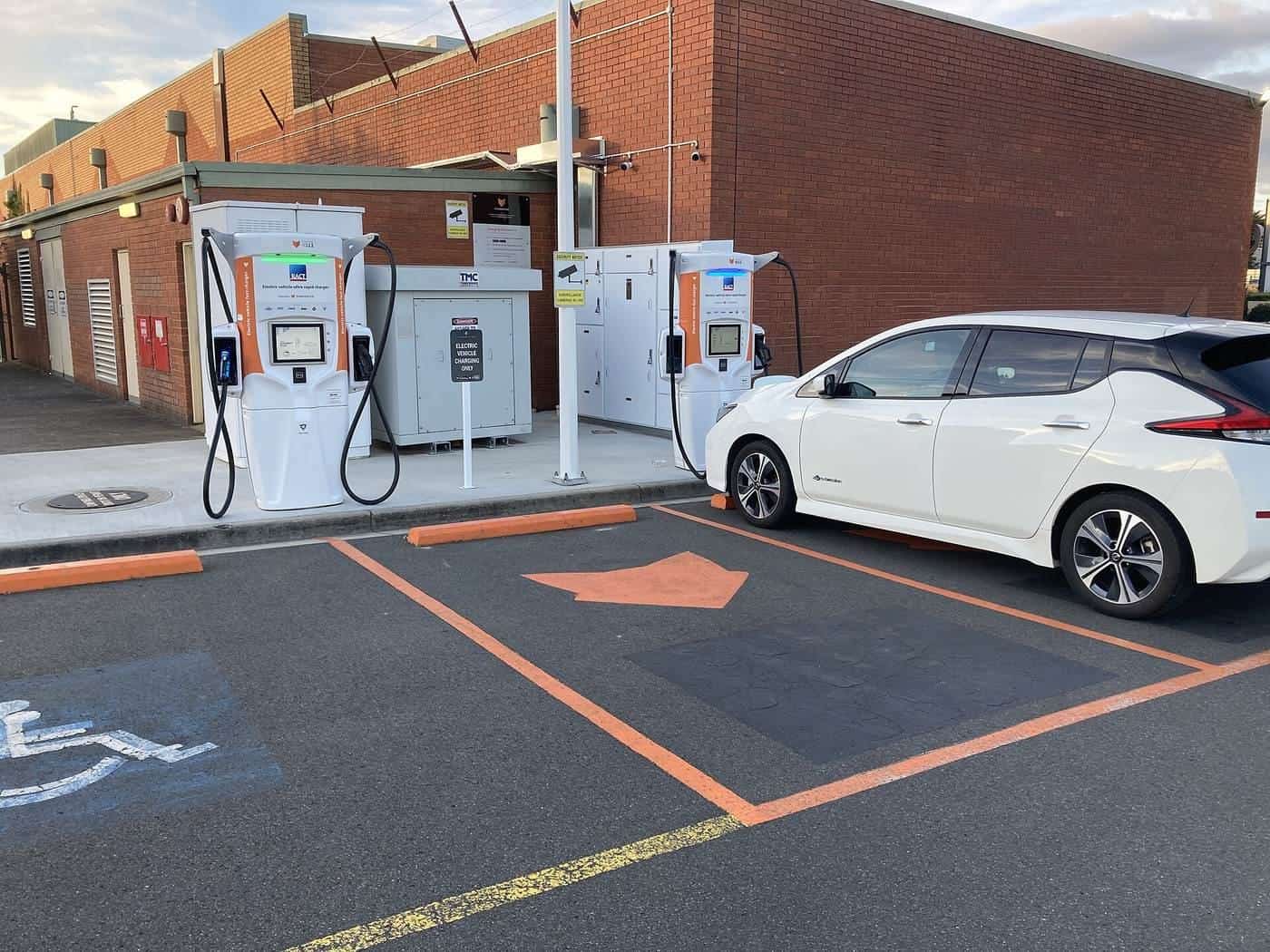
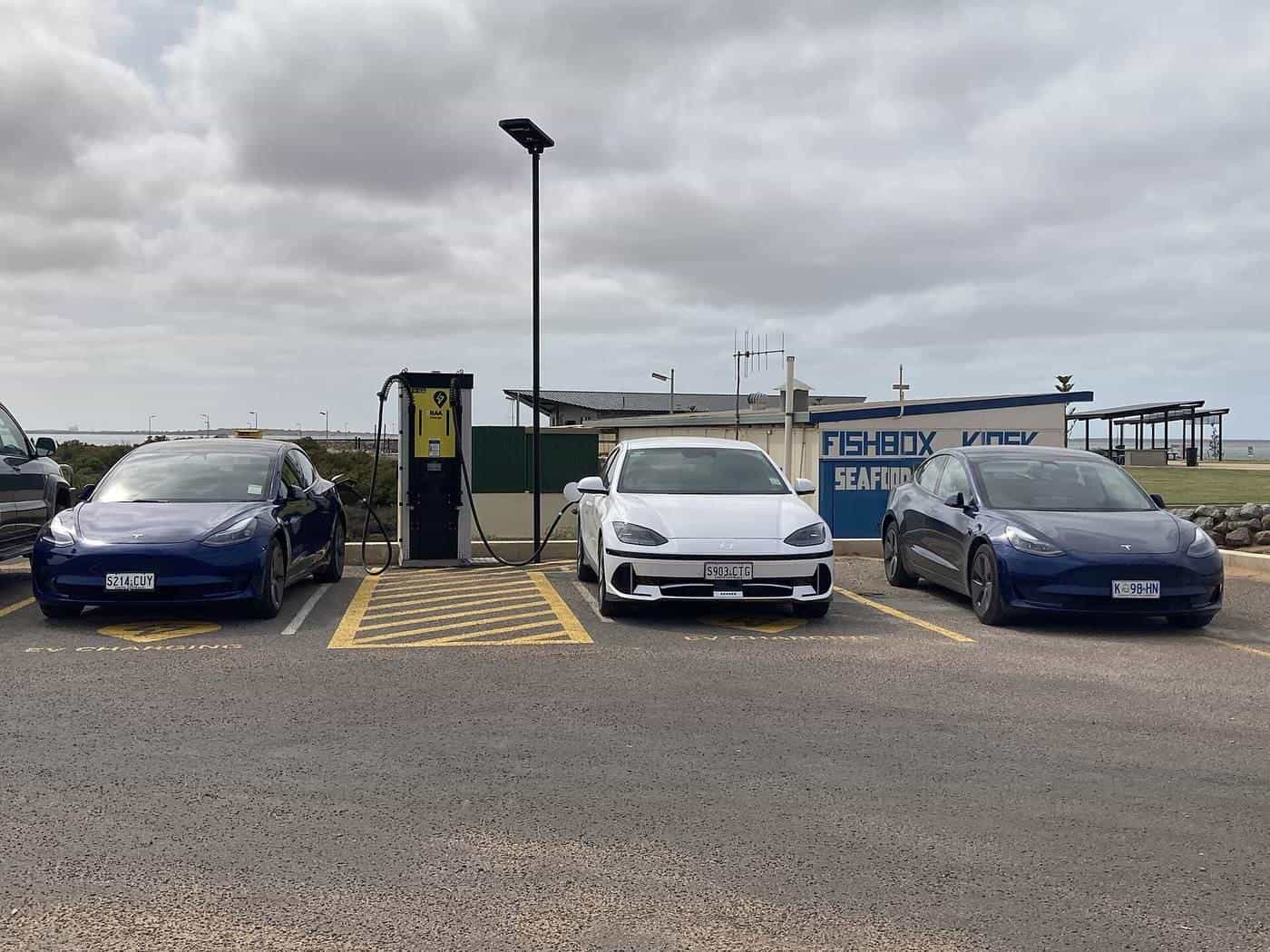
The Green Vehicle Guide says the cost of charging depends on where you charge, and that public charging stations are generally more expensive than charging at home. Energy.gov.au adds that home charging can be the cheapest way to charge, especially if you can use off-peak tariffs or rooftop solar.
In practice, many owners pay three broad kinds of rates:
- Off-peak or solar charging at home, usually the lowest cost.
- Standard home rates, if you charge whenever you plug in.
- Public charging, with DC fast charging typically the most expensive per kWh, often worth it for convenience on trips.
If you'll rely mainly on public charging, for example because you live in an apartment without a charger, your energy costs will be higher, so factor that into your comparison. See charging in apartments and rentals.
Choosing the right electricity plan
Once you own an EV, your household uses more electricity, so it's worth reviewing your plan. Things to look for:
- a time-of-use plan with a low off-peak rate overnight or in the middle of the day;
- EV-specific plans offered by some retailers, which may include a cheap charging window;
- solar feed-in tariffs, if you have panels, to understand the value of using your own solar instead of exporting it.
Compare plans with the government comparison tools: Energy Made Easy in most states, or Victorian Energy Compare in Victoria. Read the conditions carefully, because a plan with cheap EV charging may have higher rates at other times.
Comparing with fuel costs
For a petrol or diesel car, the equivalent calculation is fuel consumption (litres per 100 km) multiplied by the fuel price. The Green Vehicle Guide's fuel and CO2 calculator can estimate annual fuel costs and emissions for a vehicle. Using the same annual distance for both cars makes the comparison fair.
For a plug-in hybrid, split your driving into the share done on electricity and the share done on fuel. The more you charge, the more of your driving is on electricity. Be realistic: if you won't plug in every day, assume a larger fuel share.
Servicing and maintenance
Energy.gov.au rates maintenance costs for battery electric vehicles as medium, compared with high for plug-in hybrids, hybrids and petrol or diesel cars. EVs have no engine oil, spark plugs, timing belts or exhaust systems. They still need regular servicing of brakes, suspension, steering, tyres, cabin air filters, coolant and software.
Check the manufacturer's service schedule and capped-price servicing, if offered, for the specific model. Intervals and prices vary considerably.
Tyres
EVs are often heavier than equivalent petrol cars and deliver instant torque, so some wear tyres faster. Some come with tyres designed for low rolling resistance and low noise, which can cost more to replace. Keeping tyres at the recommended pressure helps both range and tyre life.
Insurance
Insurance premiums depend on the car's value, repair costs, your details and where you live. Get quotes for the specific models you're considering before you buy rather than assuming EVs cost more or less to insure.
Registration, stamp duty and road user charges
The Green Vehicle Guide notes that some states and territories offer discounts on stamp duty and/or registration charges for EVs. These schemes change over time, and some have ended, so check your state's transport or revenue office for current rules. Road user charges for EVs have also been a changing policy area; check what currently applies in your state.
Tax and novated leasing
If you're thinking of getting an EV through your employer or a novated lease, the fringe benefits tax exemption for eligible electric cars can make a large difference to the effective cost. The rules have conditions, and plug-in hybrids no longer qualify in most new arrangements. Read our guide to novated leases and EV tax and get independent advice.
A simple worksheet
To compare two cars, fill in these numbers for each over, say, five years:
- Purchase price including on-road costs, less any concessions.
- Annual distance × energy or fuel use × your price = annual energy cost.
- Annual servicing from the manufacturer's schedule.
- Estimated tyre replacements over the period.
- Annual insurance quote.
- Annual registration.
- Estimated resale value at the end (subtract this).
Add them up and divide by the total distance for a cost per kilometre. It won't be exact, but it will be based on your situation rather than someone else's.
Key points
- Work out charging costs from your own electricity rate and the car's official energy use.
- Home charging is generally cheaper than public charging, especially off-peak or with solar.
- Battery EVs usually have lower maintenance costs than petrol, diesel and hybrid cars.
- Check current state concessions, insurance quotes and tyre costs for the specific model.
- Compare total costs over the time you'll own the car, not just the purchase price.
Frequently asked questions
Is it cheaper to charge an EV at home or at a public charger?
The Green Vehicle Guide says it is generally more expensive to charge an EV at a public charging station than at home. Home costs depend on your electricity plan.
How do I calculate the cost of charging?
Multiply the energy you add (in kWh) by your electricity rate, and add a margin for charging losses. Our charge time estimator does this with your own rate, and the Green Vehicle Guide has a home charging calculator.
Are EVs cheaper to service?
EVs have fewer moving parts and no engine oil, spark plugs or exhaust. Energy.gov.au rates BEV maintenance costs as medium, compared with high for petrol, diesel and hybrid cars. Check the manufacturer's service schedule and prices for the model.
Are there government discounts for EVs?
The Green Vehicle Guide notes some states and territories offer discounts on stamp duty and/or registration charges. Eligibility changes, so check your state transport or revenue office.
What about the road user charge?
Road user charges for EVs have been a changing policy area. Check your state transport agency for anything that currently applies where you live.
Sources and further reading
Facts on this page were checked against these primary and official sources. Conditions change — confirm before you travel or buy.
- Electric vehicle guide (PDF) — Green Vehicle Guide
- Types of electric vehicles — energy.gov.au
- Charging options for houses and strata buildings — energy.gov.au
- New green vehicle guide driving better choices — Green Vehicle Guide